MICCAI 2026: At the time of writing, MICCAI 2026’s paper reviews have not been released yet. Based on the program schedule and author emails, 1,166 papers were accepted from 4,601 submissions (25.36% acceptance rate). There will be 99 oral and 54 spotlight talks. The early acceptance rate was 9% (of the total number of submissions) this year. Based only on the information in the program schedule, I have put together some visualizations for this year. I will update the website with the complete analysis when the reviews are released.
Background
Since 2021, MICCAI has been publicly releasing something that is potentially remarkably useful and informative, yet for a long time, I have been amazed (and occasionally disappointed) that no one1 has compiled this information in a single place for analysis: the full peer-review record of every accepted paper. It contains reviews with ratings, meta-reviews, rebuttals, post-rebuttal decisions, all sitting in the open on papers.miccai.org.
From 2021 to 2025, MICCAI has published 3,717 papers. But the corresponding review record is even more massive: 11,359 reviews, 7,642 meta-reviews, and roughly 6.9 million words of review, meta-review, and rebuttal text. Despite this scale, Paper Copilot does not list MICCAI2. So, with the help of some LLMs3 (GLM 5.2, Claude Opus 5, and Claude Design), I built it myself: MICCAI Explorer.
How I built it
I wrote a scraper for each of the five years of MICCAI review records. This was not quite straightforward because the HTML layout, the review form questions, and even the score scale have changed over the years. I then cross-referenced the scraped papers’ titles against the official annual programs to fetch information about which papers received oral presentation slots (orals and spotlights from 2024 onwards). All this scraped data, including the reviews, presentation format, open-access PDF links, DOIs, code and dataset URLs, among other fields is browsable, filterable, searchable, and sortable on the All Papers page.
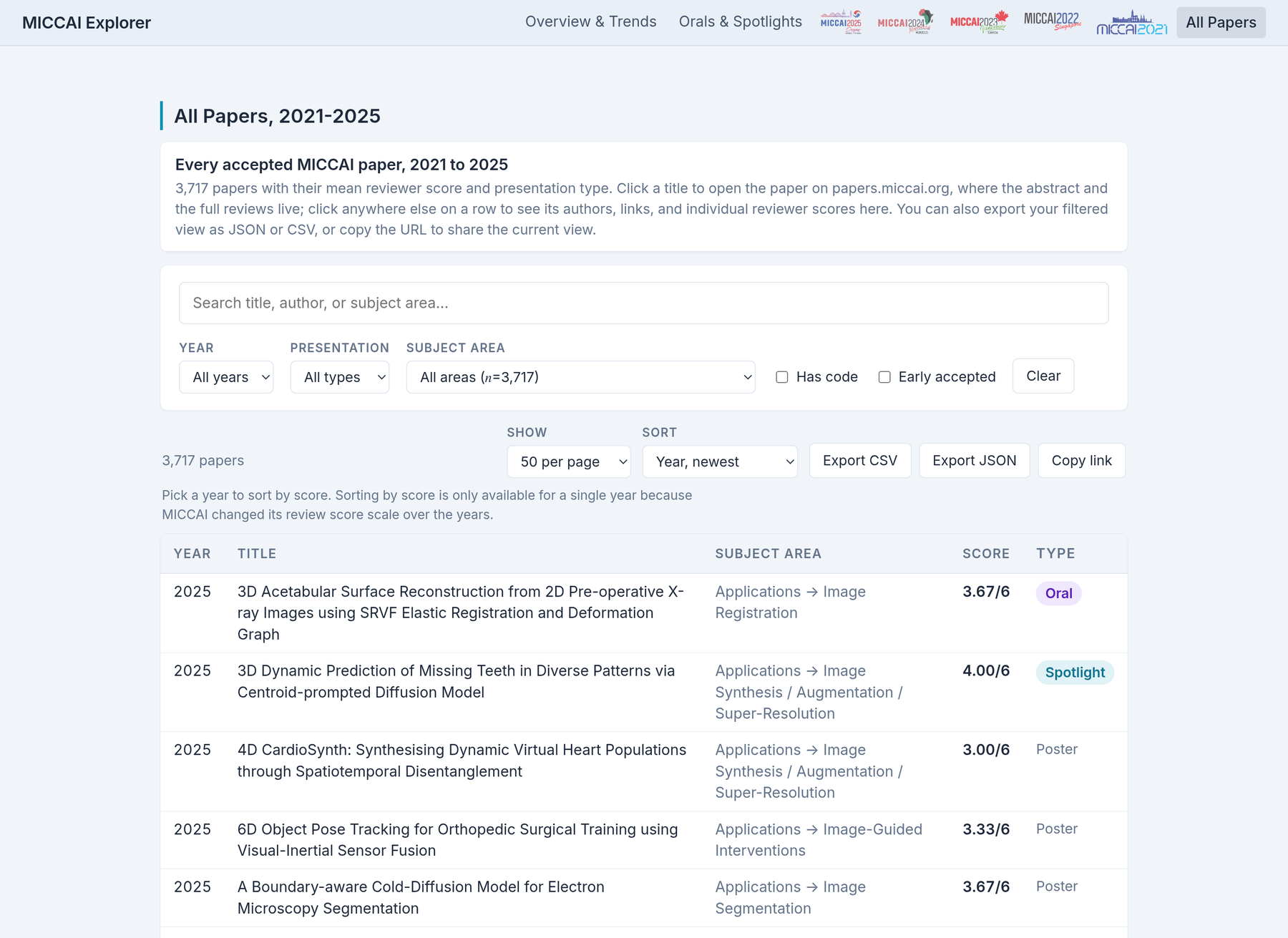
All 377 oral and spotlight talks’ paper titles from the program books exactly matched the scraped paper titles, so no fuzzy matching or manual correction was needed. However, author names are matched as strings without any disambiguation, so two authors sharing the same name are treated as the same person. An important thing to remember is that MICCAI only publishes the reviews for accepted papers, so this analysis of the reviews only covers those.
Creating a semantic map of the papers
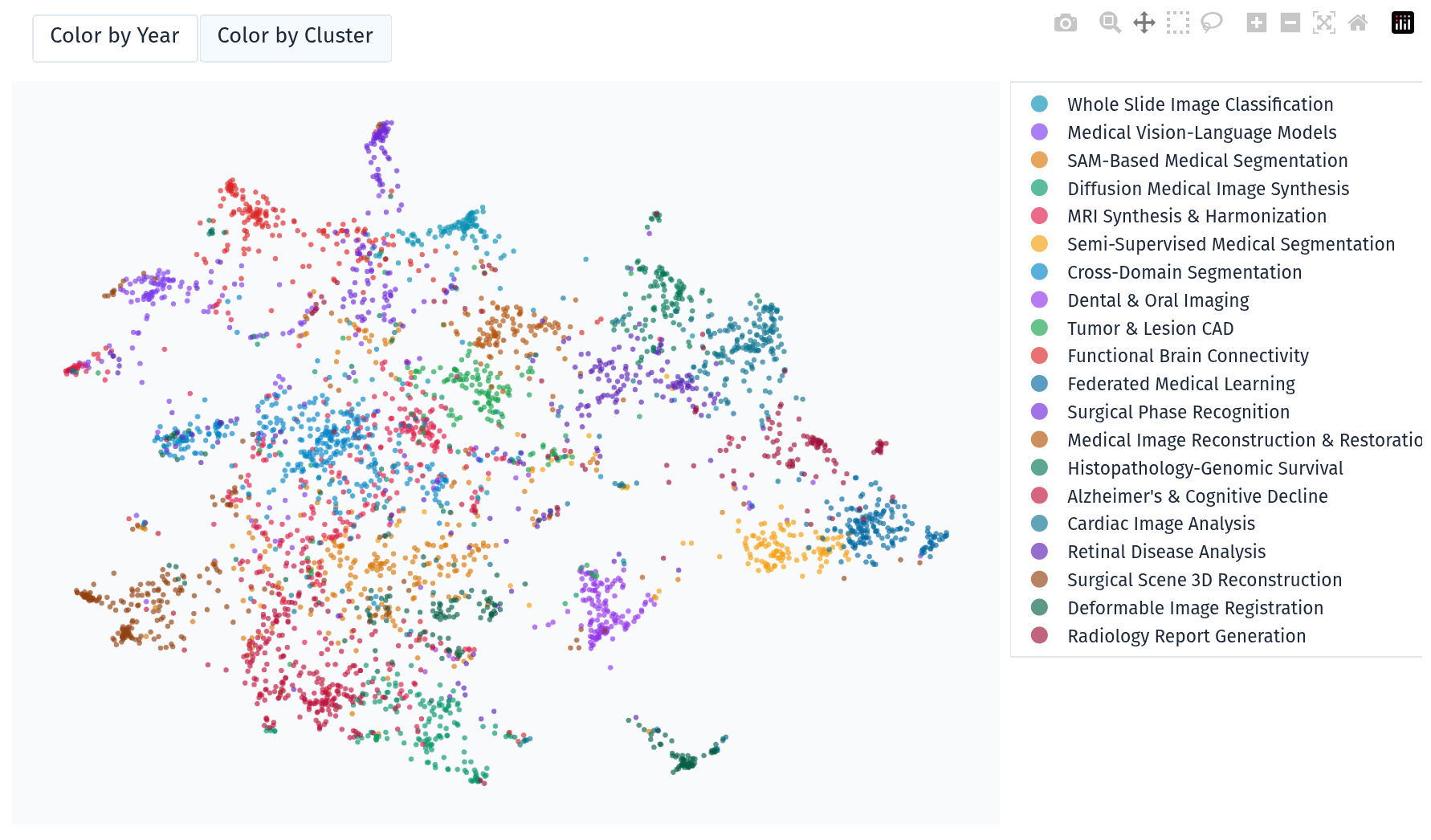
I used the SPECTER2 model (🤗allenai/specter2_base) to generate embeddings for all 3,717 papers using their titles and abstracts. I then ran K-means clustering (K=20) on these embeddings, and projected them in 2D with UMAP. Of all the models I evaluated4, SPECTER2 produced the most meaningful/coherent clustering performance, which makes sense given how it is a “scientific document embedding model”.
Five years at a glance
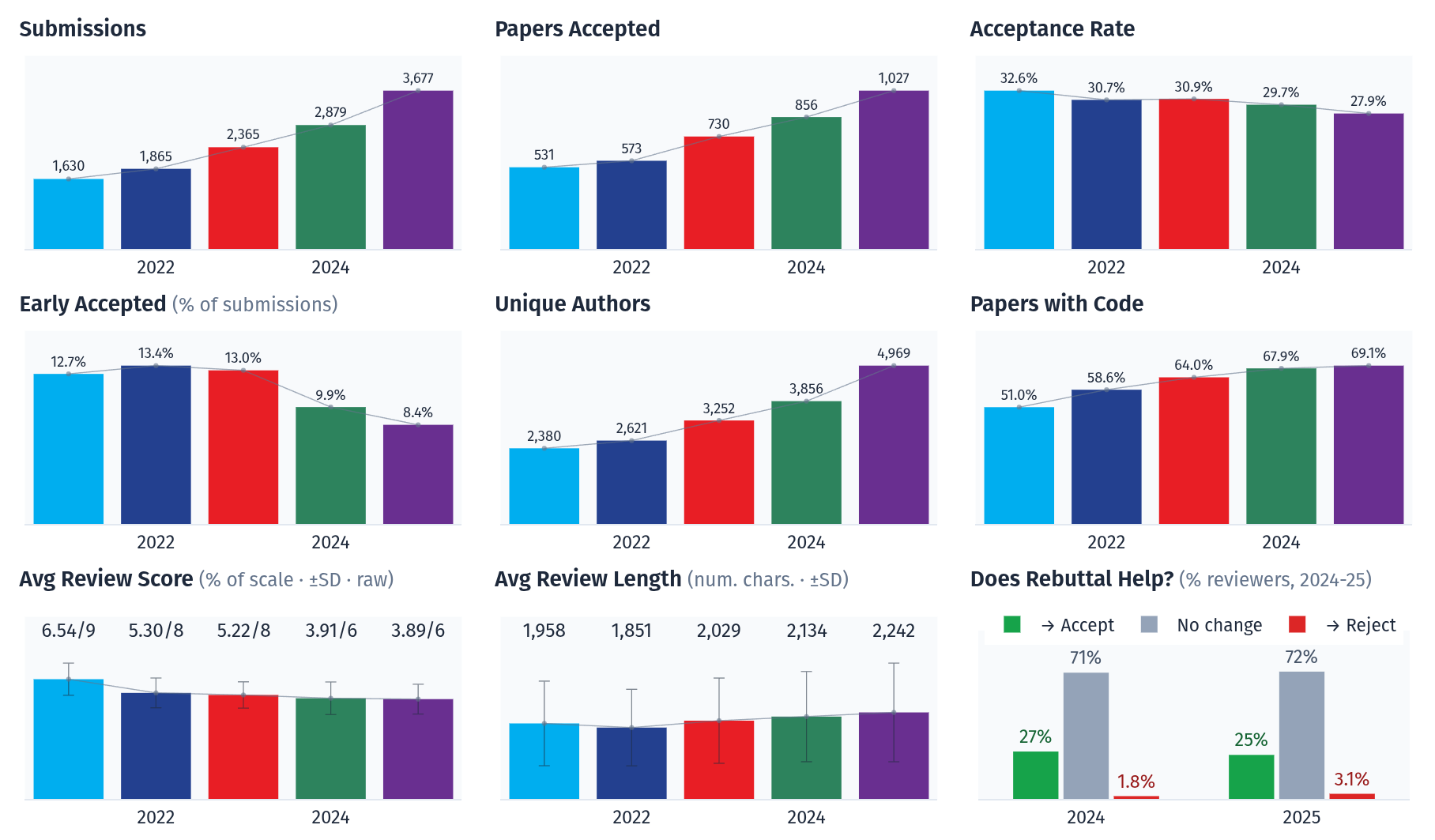
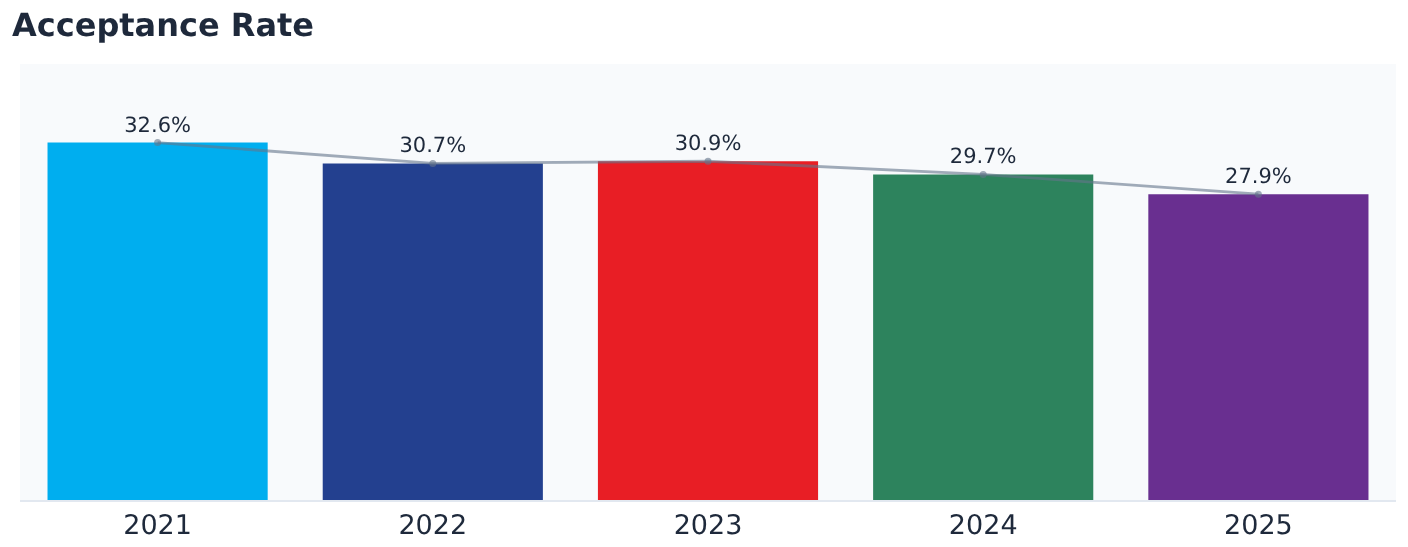
Acceptance rates have been going down.
Except for a very small uptick in 2023, the MICCAI acceptance rate has been going down steadily since 2021: from 32.6% in 2021 to 27.9% in 2025. And it continued to drop this year too: 25.36% in 2026.
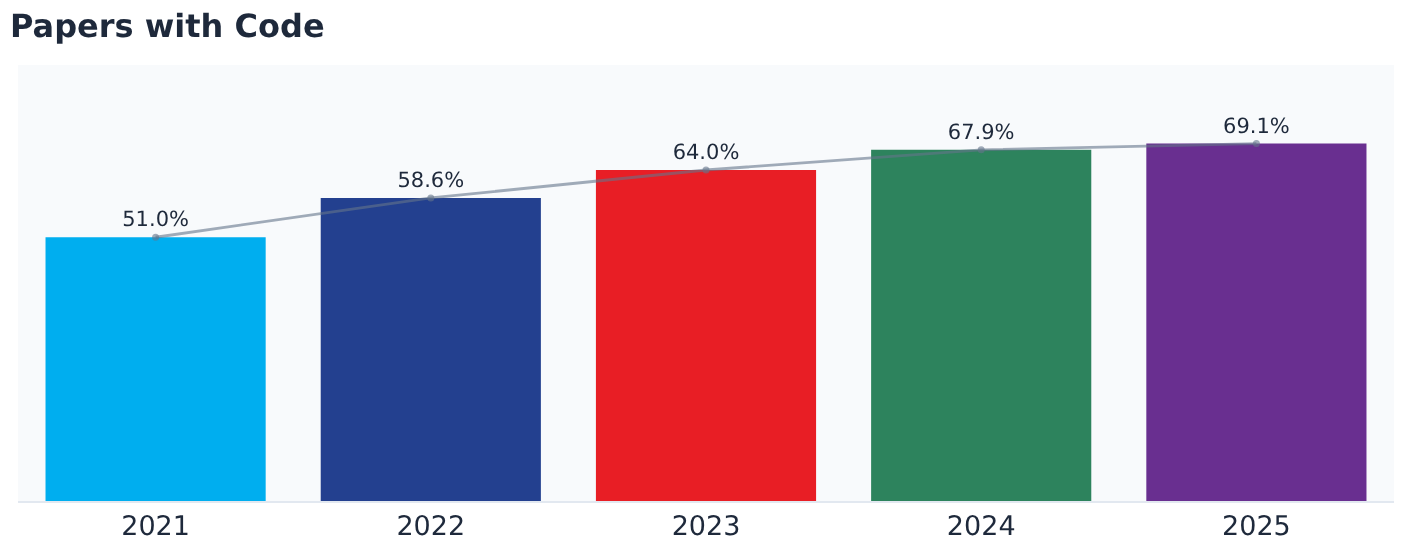
Code release is climbing steadily.
The proportion of papers with a code repository link has been going up every year: from 51.0% in 2021 to 69.1% in 2025. Things are not as rosy when one looks at the contents of the linked code repositories though, as a Professor pointed out last year.
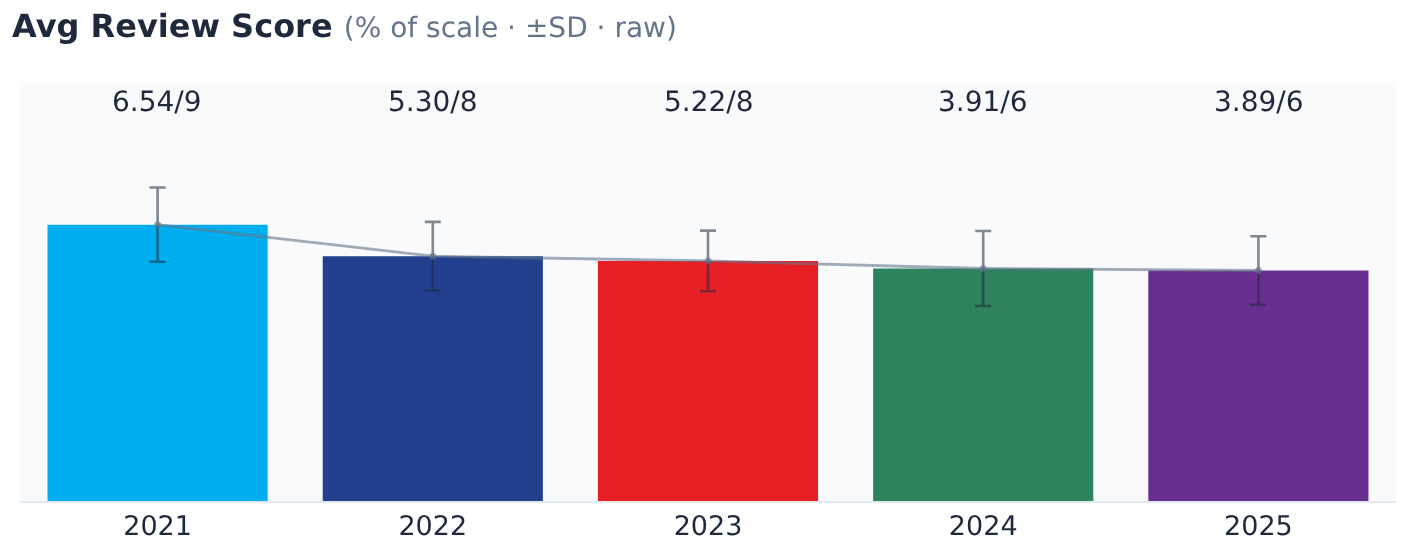
Mean review scores are going down.
Normalized to each year’s score scale, the mean review scores have been going down steadily since 2021: from 69.3% in 2021 to 57.8% in 2025. It is worth noting that this could entirely be an unintentional artifact of MICCAI changing the score scale between years.
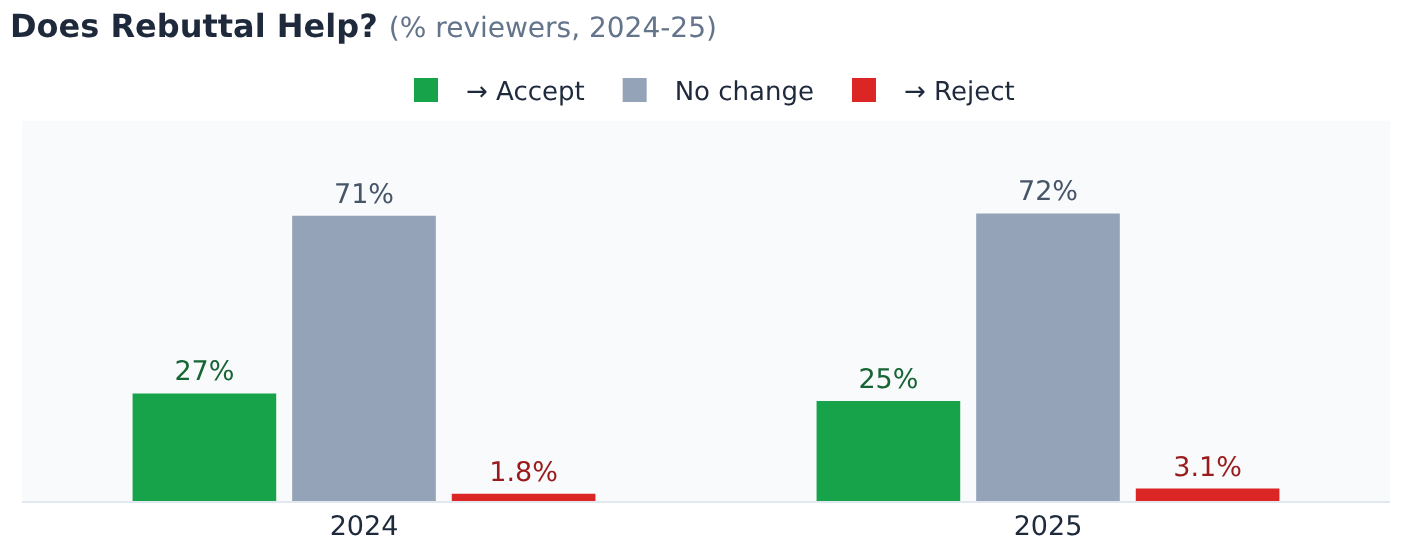
Rebuttals help change review decisions.
In 2024 and 2025, the only years where post-rebuttal decisions were recorded, 27% and 25% of the reviews who recorded a post-rebuttal decision flipped from reject (initial decision) to accept (post-rebuttal decision). On the other hand, a very small minority (1.8% in 2024 and 3.1% in 2025) flipped from accept to reject. More interestingly, 54.5% (2024) and 51.6% (2025) of papers had at least one reviewer who flipped from accept to reject.
Orals and spotlights
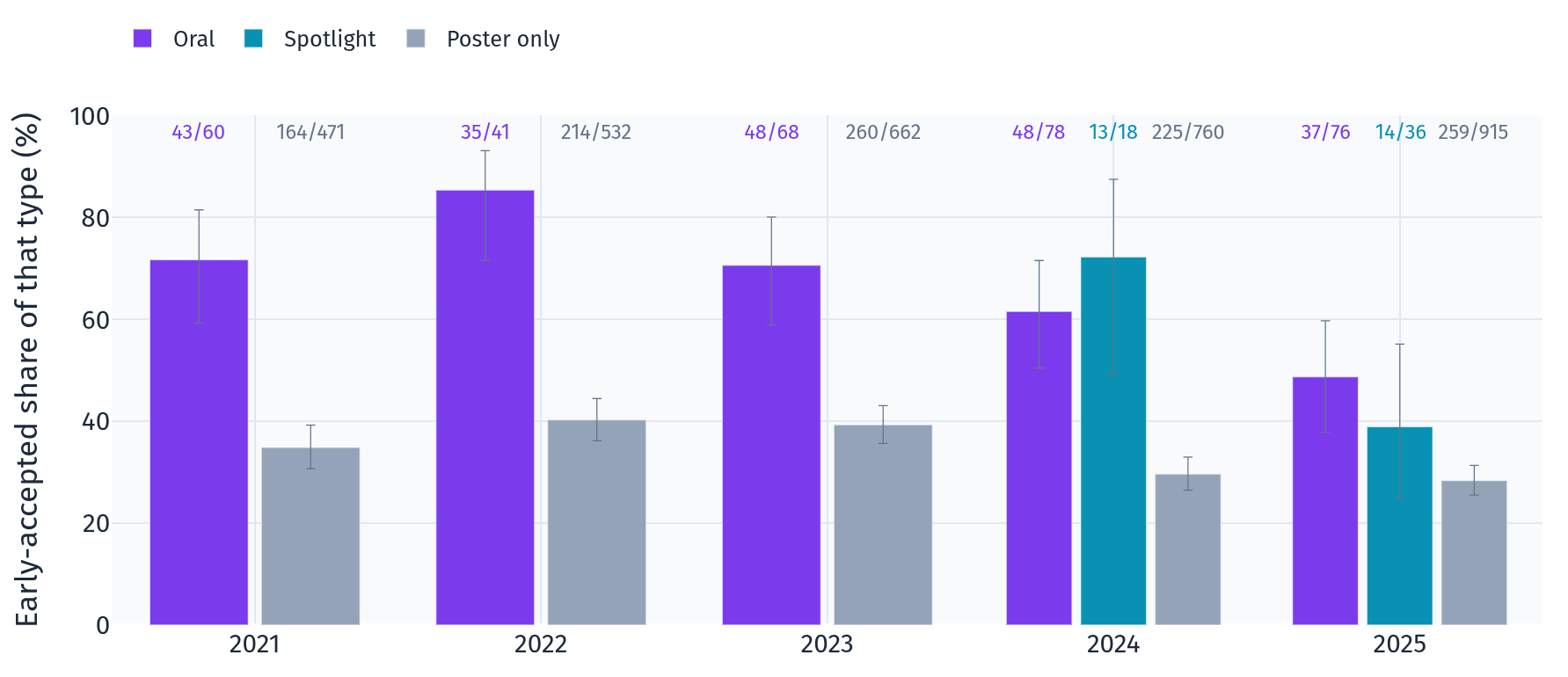
Early-accepted papers are (far) more likely to get a talk.
Pooled across all five years, 63.1% of papers that received a talk (oral or spotlight) were early-accepted. An early-accepted paper had a 17.5% chance of getting a talk (238 of 1,360 early-accepted papers got a talk), whereas only 5.9% of papers that were accepted after rebuttal got a talk (139 of 2,357 papers accepted after rebuttal got a talk). So, an early-accepted paper is nearly three times more likely to get a talk than a paper that was accepted after rebuttal.
Reviewers’ confidence has nothing to do with a paper getting a talk.
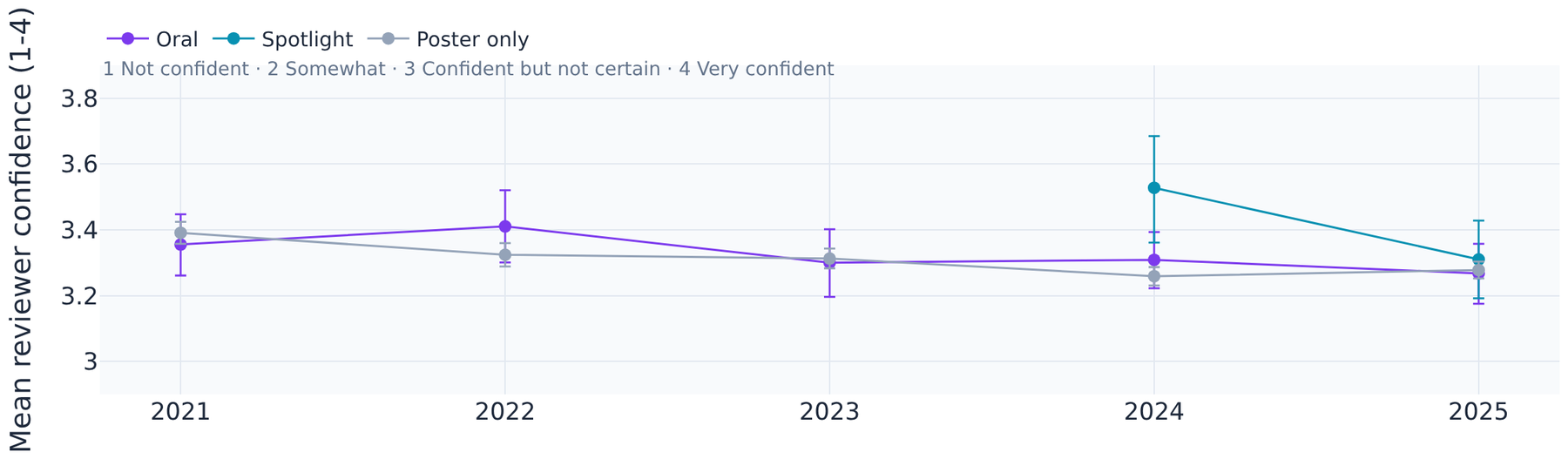
Papers that got a talk were not reviewed by more confident reviewers than papers that did not get a talk (Cliff’s δ = 0.04, 95% CI [-0.02, 0.10]). The slightly higher confidence for 2024’s spotlight talks is based on a very small sample size (18 papers), so concrete conclusions cannot be drawn from that alone.
Some subject areas are highly over-represented in the talks.
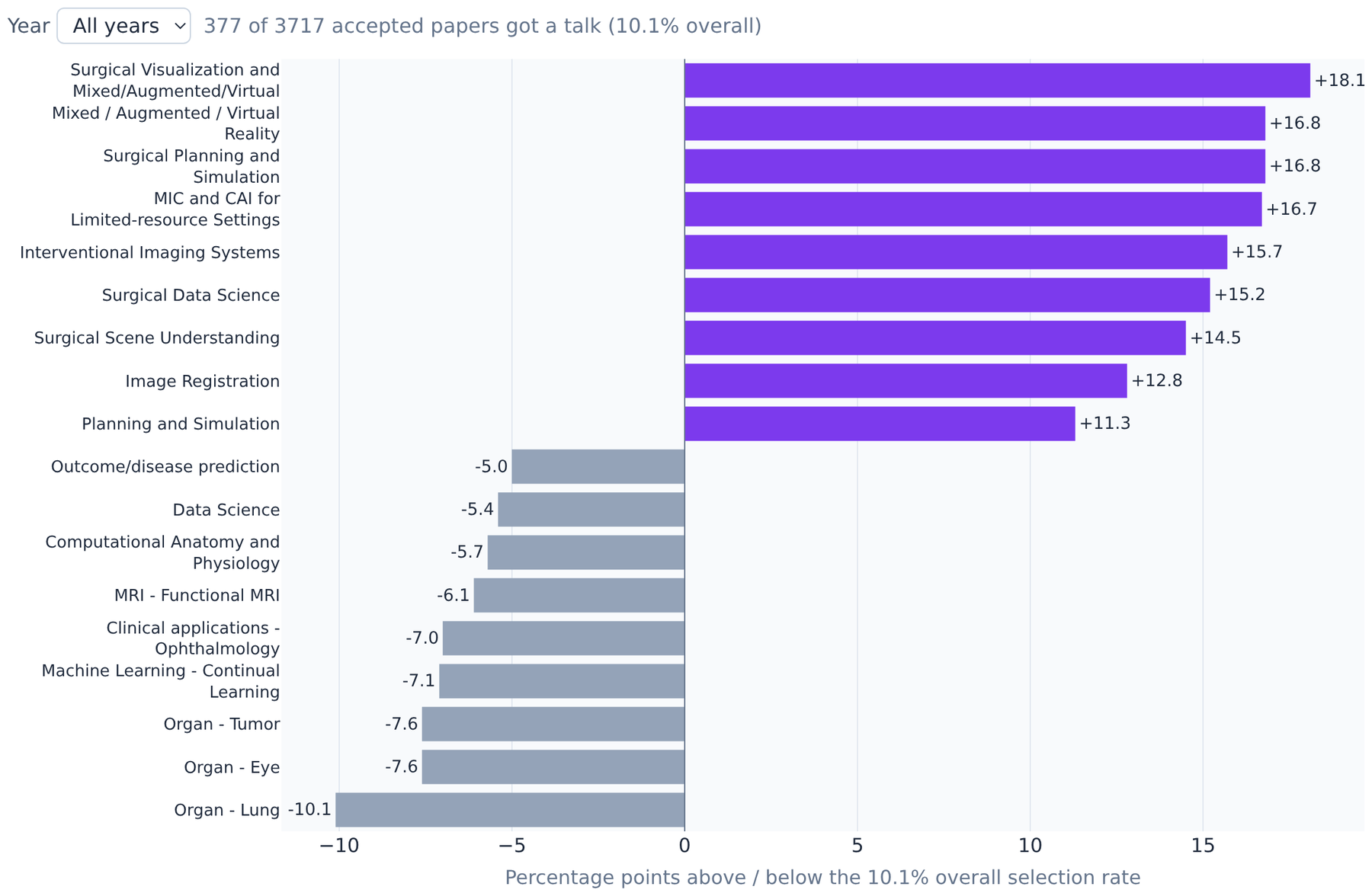
While the baseline selection rate for talks is 10.1% over the five years, six of the eight most over-represented areas are surgical or interventional, led by “Surgical Visualization and Mixed/Augmented/Virtual Reality” at 28.3% and “Surgical Planning and Simulation” at 27.0%.
MICCAI 2025: A couple of surprising discoveries
Instead of looking at the yearwise analysis for all the years, I just wanted to point out two things from the last year (MICCAI 2025).
Twenty authors account for a startlingly large share of the papers.
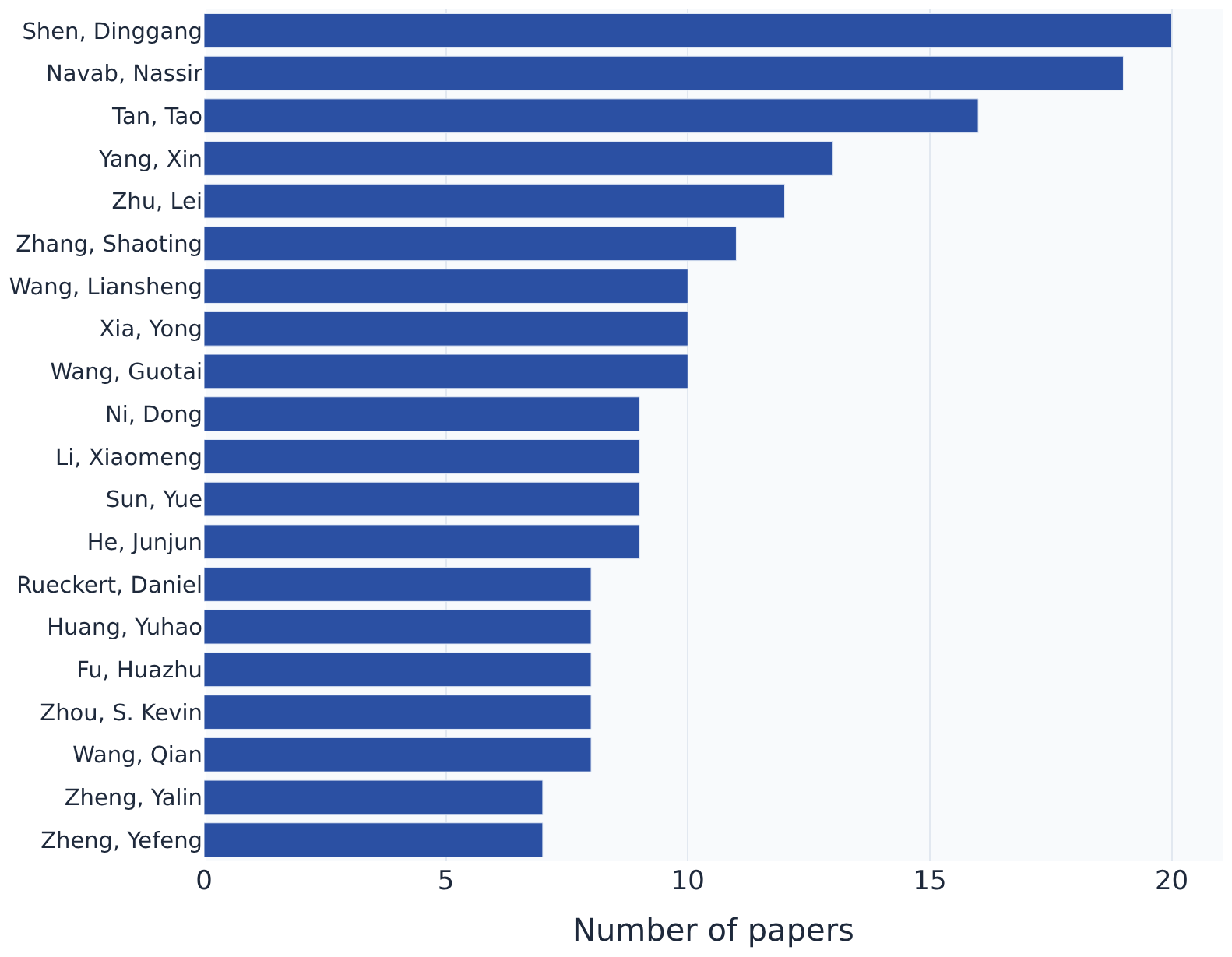
The 20 most prolific authors (who only make up 0.40% of the total 4,969 authors) of MICCAI 2025 appear on 166 papers, which is 16.16% of the total 1,027 papers.
The co-authorship networks among prolific authors have large connected components.
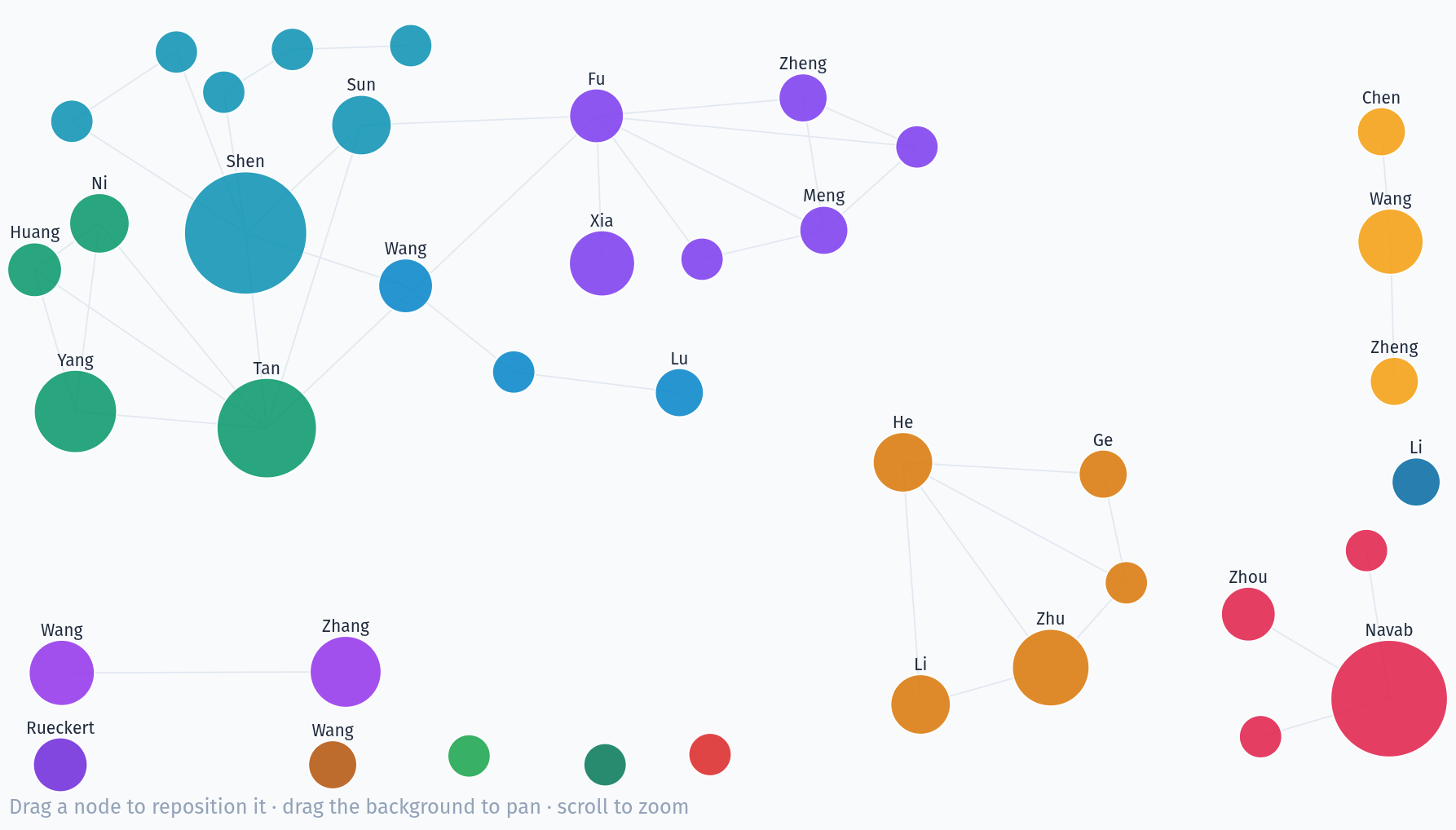
Even after filtering to authors with at least 6 papers at MICCAI 2025, half of the authors (20 out of 40) fall into a single connected component of the co-authorship graph.
Tell me what you think
The site is at miccai-explorer.github.io, and the code is at github.com/miccai-explorer/miccai-explorer.github.io. Please take a look and tell me what you think. Pull requests are welcome!
There are small-scale efforts by
ykszkfor 2024 and 2025, but they are not detailed and only look at review scores. And then thereiswas this, a rather poor attempt at automated arXiv scraping that includes non-MICCAI papers too (now deleted, but you can still see it on the Wayback Machine). ↩︎This reminds me of how CSRankings refuses to include medical image analysis conferences (MICCAI/IPMI/ISBI). ↩︎
I figured if an AI-generated “song” can be played at the Opening Ceremony of MICCAI 2025 (Suno-generated song, LinkedIn post, website post, video I took), this should definitely be acceptable. ↩︎
Other models evaluated: 🤗
sentence-transformers/all-mpnet-base-v2, 🤗BAAI/bge-large-en-v1.5, 🤗Alibaba-NLP/gte-large-en-v1.5, 🤗intfloat/e5-large-v2. ↩︎